
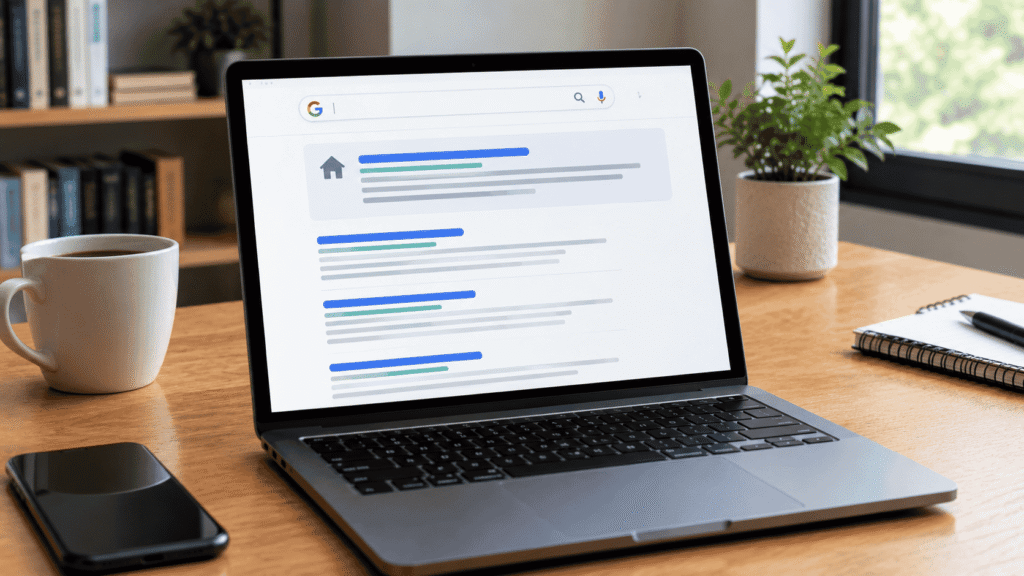
You search your main service term expecting your dedicated service page to show up, and instead your homepage ranks for the service keyword you spent time and money optimizing a separate page for. The service page itself is nowhere near the top of the results. This is one of the more frustrating quirks in SEO because it looks like your best-optimized page is being ignored in favor of a page that was never built to rank for that term.
Google Picks the Page It Trusts Most, Not the One You Intended
Google doesn’t rank pages based on which one you designed for a keyword. It ranks whichever page on your site it judges most relevant and most authoritative for that query, even if that means overriding your intended structure. When your homepage ranks for your service keyword instead of the service page, it’s because Google currently believes the homepage is the stronger candidate, usually due to authority, internal linking, or content signals rather than any manual decision on Google’s part.
Common Causes Behind This Pattern
| Cause | What’s Happening |
|---|---|
| Homepage has more authority | Most of your site’s backlinks and internal links point to the homepage, making it the strongest page overall |
| Service page is too thin | The service page doesn’t cover the topic in enough depth for Google to see it as the best match |
| Anchor text points to the homepage | Internal links across the site use the service keyword as anchor text but link to the homepage instead of the service page |
| Homepage over-optimized for the term | The homepage’s title tag, headings, or copy heavily feature the exact service keyword |
| Weak differentiation | The homepage and service page cover very similar content, so Google struggles to tell them apart |
| Navigation structure | The service page is buried several clicks deep, while the homepage is one click from everywhere |
In most cases it’s a combination of the first three: an authoritative homepage, a comparatively thin service page, and internal links that keep reinforcing the homepage’s claim to the keyword.
Confirming It in Search Console
- Filter the Performance report by your service keyword and check the “Pages” tab to see which URL is actually earning the impressions and clicks.
- Use the URL Inspection tool on both the homepage and the service page to see which one Google considers canonical for overlapping content.
- Compare word count and topical depth between the two pages honestly, not just at a glance.
- Check your site’s main navigation and footer links for anchor text that uses the service keyword but points to the homepage.
This confirms the pattern is real rather than a one-off ranking fluctuation, which matters before you invest time restructuring anything.
Redirecting Ranking Signals to the Right Page
Once confirmed, the fix is about shifting relevance and authority signals toward the service page rather than fighting the homepage directly.
- Expand the service page’s content. Add the depth, specifics, and supporting detail that the homepage simply doesn’t have room for. This alone often resolves the issue without any other change.
- Update internal anchor text. Change links across the site that use the service keyword as anchor text so they point to the service page instead of the homepage.
- Tone down the homepage’s optimization for that exact term. Keep the homepage focused on your brand and overall value proposition rather than competing head-on with the page meant to own that keyword.
- Link from the homepage to the service page using the keyword as anchor text. This passes homepage authority downward instead of having both pages compete for the same signal.
These changes rarely produce results overnight. Expect several weeks for Google to reassess relevance after a meaningful content and internal linking update, and treat this the same way you would any other item on an ongoing SEO checklist rather than a one-time fix.
If the service page and homepage are so similar that Google can’t clearly tell them apart, that’s effectively the same underlying issue that causes one page to get all the traffic across an entire site: authority concentrated in the wrong place. A structured SEO audit can map exactly where that overlap and authority imbalance exists and prioritize which page deserves reinforcement.
When Letting the Homepage Rank Is Actually Fine
Not every case needs correcting. If your service keyword is broad and closely matches your overall brand positioning, having the homepage rank for it can work perfectly well, especially for smaller sites with only one or two core services. The situation becomes worth fixing specifically when the service page offers something the homepage can’t, like detailed pricing, process information, or conversion-focused content that visitors need but never see because they land on the homepage instead.
Frequently Asked Questions
Filter the Search Console Performance report by that query and check the Pages tab. It will show exactly which URL Google is actually serving for that term, rather than which page you intended to rank.
No, and it can make things worse. Redirecting your homepage isn’t an option, and manually swapping which page targets the term won’t change the underlying authority and linking signals that caused Google to prefer the homepage in the first place.
Typically several weeks after meaningful changes, such as expanding the service page’s content and updating internal anchor text. Google needs to recrawl the affected pages and reassess relevance, so this isn’t something that shifts overnight.
Not entirely. The goal is to stop the homepage from directly competing with the service page for the exact term, not to strip the topic from your brand messaging altogether. A brief, natural mention is fine; heavy repetition and exact-match headings are what cause the conflict.
It’s closely related. Cannibalization usually refers to two or more content pages competing for the same query, while this pattern specifically involves the homepage outranking a dedicated page, but the underlying fix, consolidating authority and signals toward one clear page, is the same.
The Takeaway
When your homepage ranks for your service keyword instead of the page built for it, the cause almost always comes down to authority and internal linking rather than any penalty or mistake. Confirm the pattern in Search Console, then work on strengthening the service page’s content and redirecting internal anchor text toward it rather than trying to suppress the homepage. In cases where the homepage’s ranking already serves visitors well, it’s worth asking whether correcting it is actually necessary before investing the effort.